
Mat-Su superintendent cites incorrect data in homeschool funding presentation after AI use
Mat-Su School District Superintendent Randy Trani cited spending data from Galena, Illinois, instead of Galena, Alaska.
What you need to know:
- Mat-Su School District Superintendent Randy Trani incorrectly cited spending data from an Illinois school district during a school board meeting this month, mistaking it for Alaska’s Galena City School District. The error stemmed from an AI-generated summary published on the Citizen Portal website.
- Trani used the incorrect data in a board presentation to criticize Alaska’s state correspondence school funding system. He publicly acknowledged the error and pledged to correct the record after it was flagged by Galena, Alaska, officials, but did not address a series of other inaccuracies Galena officials said were also included in the presentation.
- The incident comes as Mat-Su officials grapple with ongoing budget challenges and tensions over state education funding rules for homeschool and correspondence programs.
- Short on time but need the local news scoop? Get free weekly news in your inbox for Mat-Su, from Mat-Su.
PALMER — Spending data incorrectly presented last week by Matanuska-Susitna Borough School District Superintendent Randy Trani as being from the rural Interior Alaska Galena City School District was actually from a similarly named district in Illinois.
Galena, Alaska officials pointed out the error Monday morning.
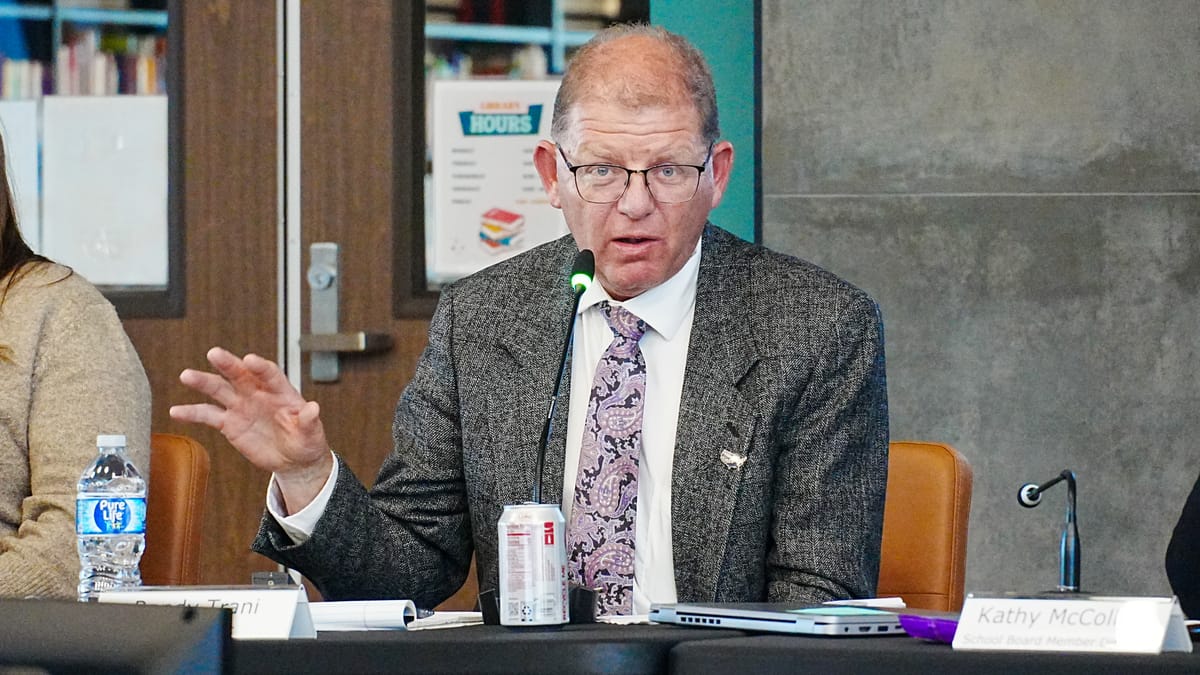
Trani said he sourced the data from an AI service. He used the information during a school board meeting Wednesday to criticize state school funding rules, which allow students to enroll in any Alaska district correspondence school regardless of where they live. The rules siphon away state education money that could otherwise go to students’ home districts, he said.
Galena, a city of about 500 people on the Yukon River west of Fairbanks, serves about 300 in-person students from the region. It also receives state funding for nearly 8,400 students enrolled in its IDEA correspondence school. Of those, 2,600 live in Mat-Su, according to state education data presented by Trani.
Each of those students carries thousands in state education funding, he said, that could be subject to “local control” if it were instead delivered to the district where students live, rather than spent on Galena priorities — which he incorrectly said included a new $31 million building for the district’s roughly 185 residential high school students.
But that statement was based on inaccurate information sourced from an AI-generated public meeting summary published to the Citizen Portal website and incorrectly attributed to Galena, Alaska, Trani said in a statement Monday evening. Citizen Portal’s AI program incorrectly tagged a summary of an August Galena Unit School District meeting in Illinois as being from the Galena City School District in Alaska, he said.
“I regret the confusion this error caused and understand why it raised concern,” Trani said in the statement. “Accuracy matters, especially when discussing communities and school systems that people care deeply about. Once the issue was identified, it was important to correct the record publicly and clearly. I have corrected this error on our MSBSD website and will correct the error publicly at our next board meeting. I have reached out to other elected officials as well as leadership of Galena City Schools.”
Citizen Portal automatically generates AI summaries and transcripts from video recordings of local meetings across the U.S. Trani noted in his slides and during his presentation Wednesday that his information was AI-sourced but did not respond to a request for comment about whether or how he fact-checks such material.
The Citizen Portal website includes a note disclosing the use of AI and recommending users watch full meeting videos “for complete details and context.” A Mat-Su Sentinel review of Citizen Portal meeting summaries conducted last year found the site regularly publishes inaccuracies and should not be used for news reporting.
Galena City School District Superintendent Jason Johnson flagged the incorrect information in a letter sent Monday morning to families enrolled in IDEA. Johnson wrote the letter to raise “awareness to our IDEA families,” he said in an email Monday night.
Trani’s nearly 15-minute school board presentation also included a series of other inaccuracies about Galena City School District’s operations and spending, Johnson said in his letter to families.
A series of construction projects on buildings operated for the Galena Interior Learning Academy residential school — characterized by Trani as future projects — were actually completed between 2011 and 2019, and all but one were grant-funded, Johnson said.
A swimming pool that Trani said an unidentified Alaska lawmaker told him was paid for by state money tied to IDEA students living outside Galena was actually built about 25 years ago, Johnson said. And a pair of photos from Galena’s social media pages that Trani said showed the district’s traveling water polo team in uniform and during practice actually depicted a girls’ volleyball team and the district’s swim team playing a game of water polo.
“For the record, GCSD does not have a water polo team, nor anything budgeted for such a team,” the letter states. “The student photograph depicted our volleyball team, wearing knee pads and holding a volleyball. The photograph of the swimming pool notates the words ‘swim practice,’ ‘swimmers,’ and ‘swimathon,’ clearly depicting this as a swim team and not water polo.”
IDEA was first opened in 1997, according to their website.
Trani’s statement did not address the additional inaccuracies Johnson identified in his letter. Trani did not respond to a request for comment Tuesday regarding those details.
‘Local control’ for correspondence student funding
The presentation and inaccurate spending examples come as Trani and his team prepare to address an anticipated $23 million district budget shortfall for the 2026-27 school year.
That’s a budget squeeze Mat-Su administrators said could be eased by changes to state education funding rules, including per-student payments for those registered in district homeschool programs and tying funding to where students live rather than where they are enrolled.
By passing state funding for students based in Mat-Su — about $7,000 per student — to the Galena program, instead of giving at least a portion of it to Mat-Su, the state allows Galena’s board to spend on local needs while Mat-Su faces significant cuts, Trani said during the presentation.
And because state law allows students to use local school resources or participate in sports regardless of which district is receiving their funding, those students are still costing the district money, he said.
“We may have to cut bus routes; we may have to close schools. We’re going to be making these decisions. … That decision was not driven solely by us; it was driven by this other board in another district because they aren’t allocating the resources for the students they have in the Mat-Su to benefit them as much as they are the 350 kids who live in Galena.”
Trani said the problem should be addressed by state officials.
“I’m not blaming Galena for doing this; it’s the way it currently is,” he said. “I just think we probably need to look at it at the state level.”
Johnson said Trani’s presentation and statements represent an effort to block Alaska homeschool parents from choices.
“Again, under less serious circumstances, offering a presentation with such egregious and destructive errors would be amusing, but these false statements may become persistent, divisive dialogue that will impede your freedoms if not checked and addressed with facts,” the letter states.
About 3,670 students are enrolled in Mat-Su School District correspondence programs, Trani said. Of those, about 330 live in other districts.
About 3,900 students who live in Mat-Su are enrolled in correspondence programs operated by other districts, according to data presented by Trani. That includes about 2,600 students in Galena’s IDEA program and about 630 in Raven Homeschool, which is operated by the Yukon-Koyukuk School District.
Wednesday’s presentation follows a major change last year that reshaped the Mat-Su Central homeschool program, updating how the state calculates funding for students enrolled in a mix of in-person and correspondence courses. It also added a new diploma option for homeschool students with less rigorous academic requirements.
Those changes were designed to attract more students to the Mat-Su program, Trani said last year.
Enrollment in Mat-Su’s homeschool programs at Mat-Su Central, Twindly Bridge, and Knik Charter School increased by about 230 students this year, according to state data Trani presented Wednesday, while 250 new students transferred from Mat-Su schools to non-district correspondence schools.
Overall student enrollment across all district schools is down 175 students year-over-year, with 18,737 students, according to district data presented last month.
-- Contact Amy Bushatz at contact@matsusentinel.com