
Does Palmer have a major parking problem? Early study insights say no.
The study examines whether Palmer should update its downtown business parking rules.
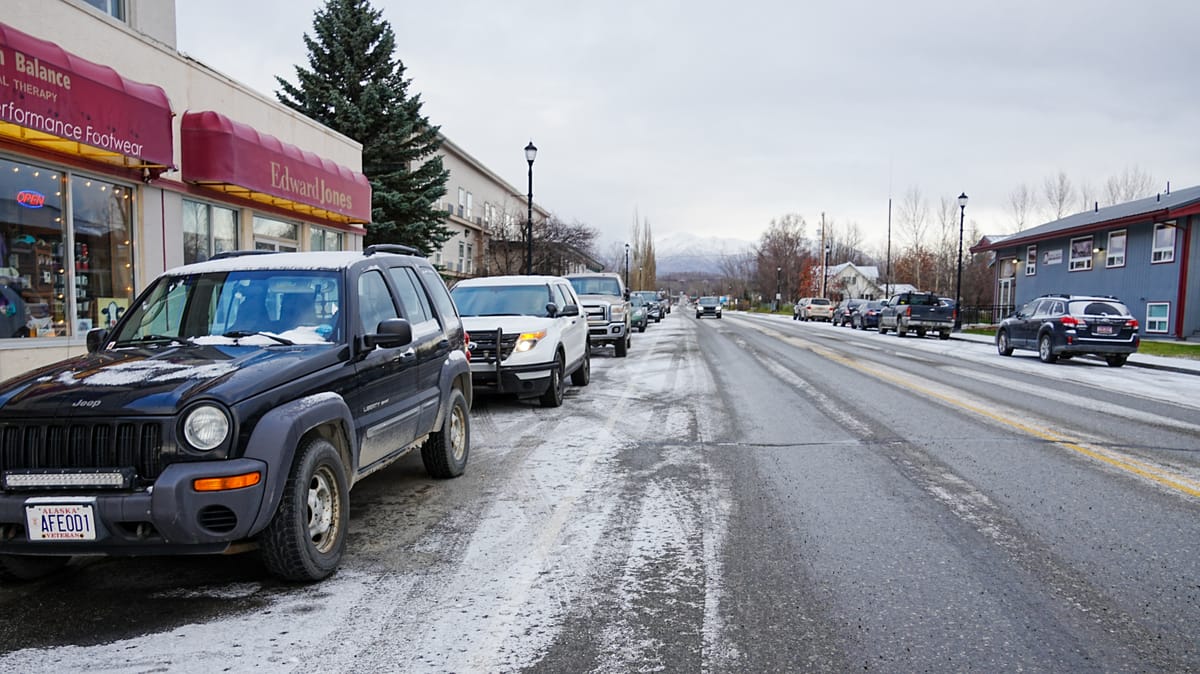
What you need to know:
- Early insights from a Palmer parking study show most users don’t have difficulty finding parking downtown, though concerns remain about ADA accessibility, pedestrian connectivity and event-specific parking.
- The full parking report is expected next year and may include recommendations for updating parking policies and improving pedestrian access. The study was launched after a controversy last year over whether a planned restaurant with seating for more than 100 patrons could rely on public parking.
- Some downtown business owners oppose a recent proposal to eliminate most parking regulations, saying it could lead to shortages and misuse of privately maintained lots. They said the rules should be updated to reflect how people typically travel.
- Short on time but need the local news scoop? Get free weekly news in your inbox for Mat-Su, from Mat-Su.
PALMER — Early insights from a study examining parking and walkability in Palmer’s downtown business area show that most users don’t have trouble finding places to park, a planner leading the city review said last week.
“Having done a high-level review, the consensus is that parking is not a significant challenge for most people in Palmer,” said Maija DiSalvo, a planner with the consulting firm RESPEC, which the city contracted to conduct a strategic review and plan for parking and walkability in the business area.
Comments received during the study’s approximately four-month survey also highlight concerns about accessibility for disabled users, pedestrian connectivity, and a lack of information about where visitors can park during regular events, which can overwhelm the area with vehicles, DiSalvo said.
“I think the ADA accessibility and some of those safety concerns and missing pieces of connectivity do come up, and event-specific parking,” she said. “So maybe having more clarity on where to go during those higher-volume times could be helpful, or signage.”
DiSalvo and Palmer community development officials hosted an open house Thursday at the Palmer Depot for the final evening of the project’s survey process. About a dozen residents and local business owners attended.
The survey, which opened in July, gathered feedback from about 350 individuals through an online form, officials said. DiSalvo also interviewed about two dozen local business owners in the downtown area selected by RESPEC in partnership with the city, she said.
The project’s full preliminary results and recommendations will be available for review in early January, including suggestions on whether city officials should update parking laws, public parking placement, or pedestrian and bicycle access. A final report is expected in early spring, she said.
Palmer’s current business area parking laws dictate the number of parking spaces required for about a dozen types of businesses and dwellings. For example, restaurants must provide one parking space for every five seats; retail shops must have one space per 500 square feet of floor area; and hotels must have one space for every three guest rooms, according to city code.
A Palmer City Council proposal to eliminate most business parking rules in the downtown area sponsored by Council member Victoria Hudson this fall was tabled until the parking study is complete.
The $50,000 study was commissioned by city officials this summer after the issue became a flashpoint last year. A local business owner, Troy Vincent, had posted on his business’s Facebook page that other local businesses had coordinated with the city to hold a special council meeting to block his request for a parking waiver for his planned barbecue restaurant.
Vincent later deleted the post and said he misunderstood the origin of the meeting and the process for parking waivers. While local business owners did testify against his plan, which included relying on nearby public parking to serve up to 130 guests, they did not request the public meeting or privately orchestrate the denial, city records show.
Palmer business owners Wes Artz and Michelle Kincaid said at Thursday’s meeting that they purchased additional lots to comply with current parking regulations. Artz owns the Palmer Bar and the parking lot behind it, and Kincaid owns the Valley Hotel, the Koslosky Center and several nearby or adjacent parking lots.
Artz and Kincaid said the perception that there isn’t a parking problem is because the city has rules for its use. Without those, they believe parking will become a major problem that could drive visitors away, they said.
Instead of eliminating the parking requirements, the city needs to update them, Kincaid said. For example, one space per three hotel rooms not reflect how visitors actually travel, she said.
“The reason I think we don't have much of a parking problem is because there are codes,” Kincaid said. “We’re only required to have one parking space for every three hotel rooms. Well, where did my other two customers park? So that's why we purchased more parking, because we knew we needed it for the hotel.”
Artz and Kincaid said they worry that eliminating the regulations would allow new businesses to open without any plan for customer parking, causing a ripple effect that fills their private lots with users visiting other businesses and leaving no space for their own patrons. They said they do not strictly monitor their parking lots, but if the city removes parking rules, that could change.
Kincaid said she has priced out adding fencing to her lots to regulate who parks there and protect the spaces for her visitors. Artz said he would consider using lack of parking requirements to build new business space over his lot and push customers to public parking elsewhere.
-- Contact Amy Bushatz at contact@matsusentinel.com
This article was updated Nov. 4 to correct the spelling of Michelle Kincaid's name.