
Mat-Su disability advocates praise progress and push for more at state Capitol
The Palmer residents joined other advocates from Key Coalition for Alaska to lobby for support, including universal changing stations for people with disabilities.
What you need to know:
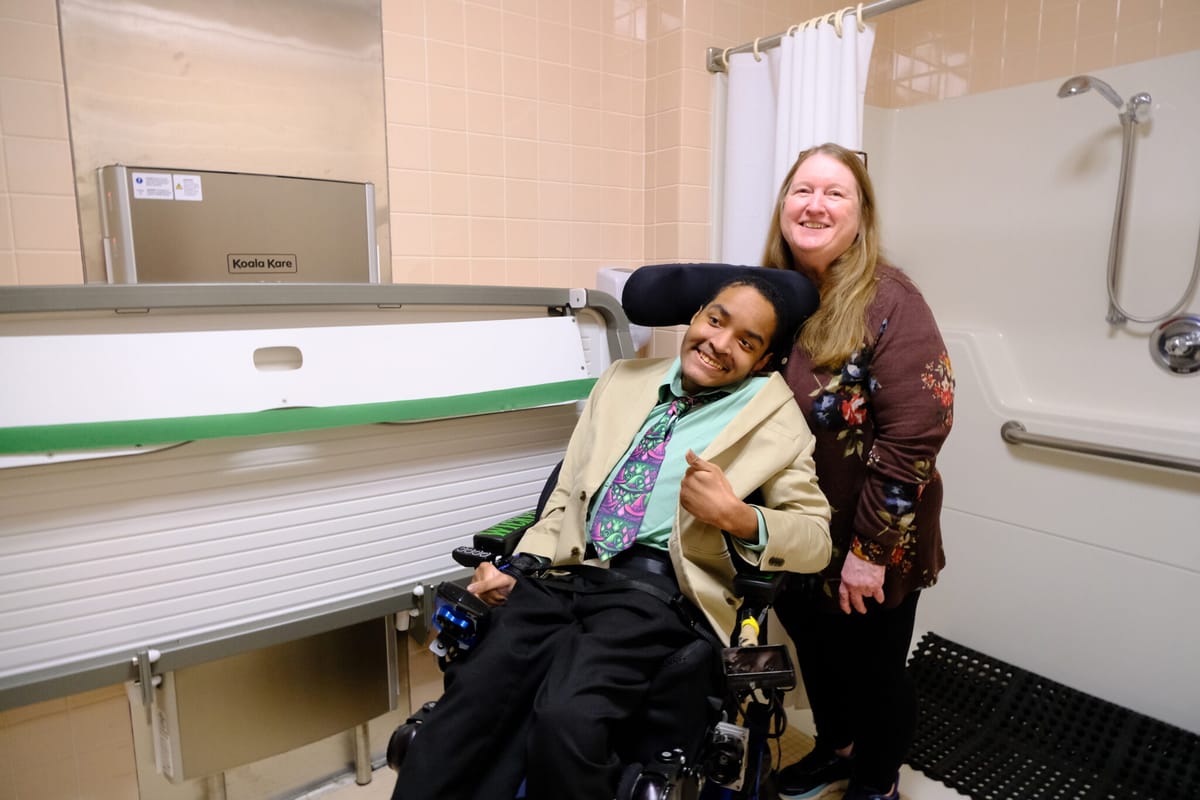
- Palmer residents Judy and Eric Edwards traveled to Juneau to advocate for better accessibility across Alaska, pushing for more universal changing stations and broader support for people with disabilities.
- A new adult-size universal changing station at the Alaska State Capitol marks a step forward, providing a safer, more dignified option for people who need assistance and easing challenges for caregivers like Judy. Judy and Eric, who is a student at Colony High School, regularly attend public meetings around Mat-Su to advocate for such changing stations.
- Advocates and lawmakers are pursuing broader changes, including legislation to require changing stations in public buildings and efforts to improve Medicaid access, transportation and early intervention services.
By Corinne Smith
Alaska Beacon
JUNEAU – Judy Edwards and her son Eric traveled from Palmer to advocate for people with disabilities at the Alaska State Capitol in Juneau this week, and now one part of that process is a bit easier.
A newly installed universal changing station on the first floor of the Capitol is a clean, safe space for people who need assistance when using the restroom. The changing station is adult-size and adjustable, for people who use adult diapers and need help changing them. This is an upgrade for Eric, who is 18 years old and has quadriplegic cerebral palsy with dystonia and uses a power wheelchair.
Previously, he and his mother would have had to use the floor.
“This will make life easier for everybody,” Judy said. “Parents, especially younger parents, they just deal with things, but they shouldn’t have to. You know, parents hurt themselves because they’re trying to lift from the floor.”
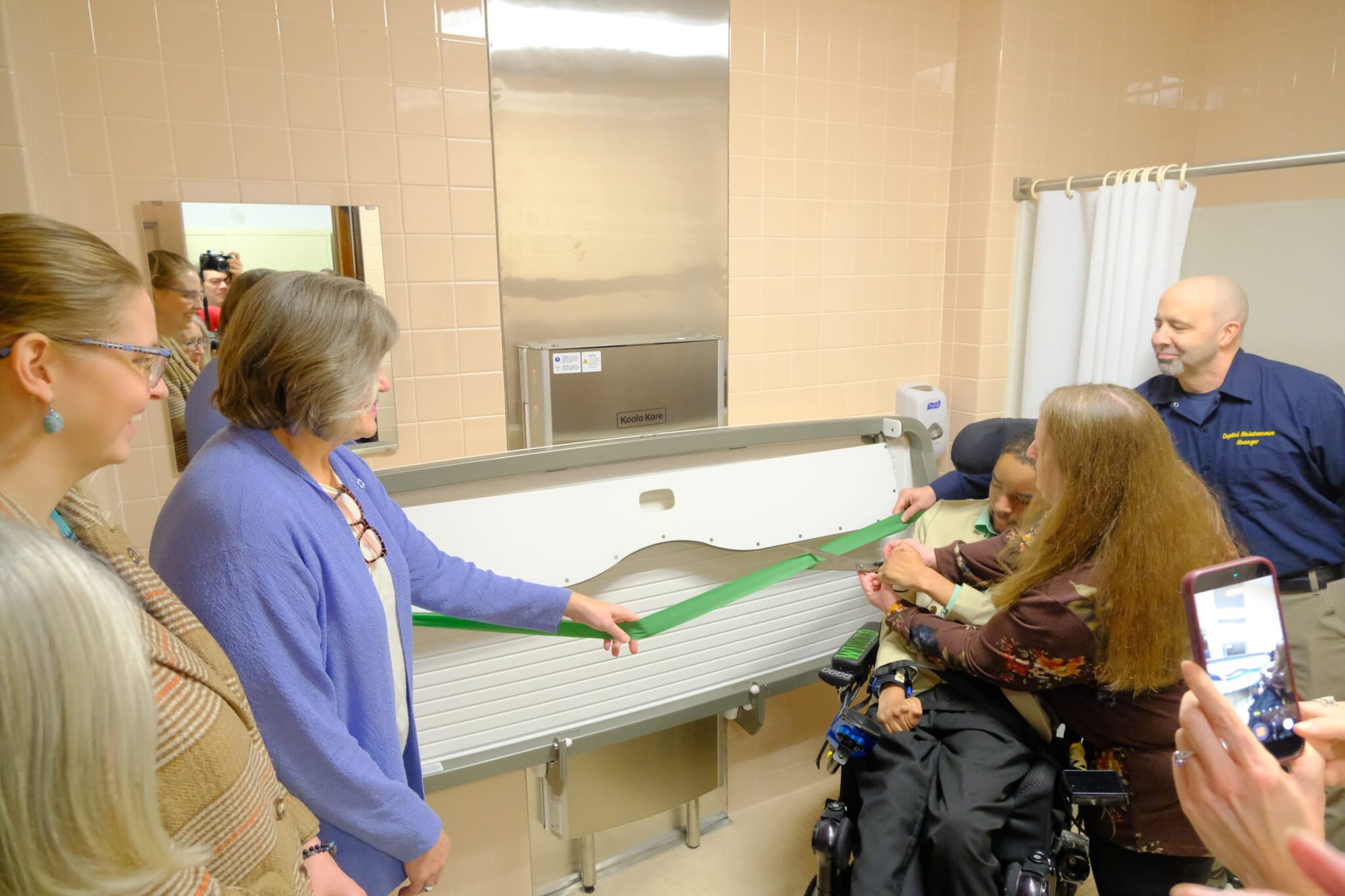
At a ribbon-cutting ceremony on Thursday, lawmakers and advocates with the Key Coalition — a group of people with disabilities, their caregivers, service providers and supporters — gathered to applaud the new installation.
“I am so sorry that you’ve had to advocate for this and that those of us who are able bodied don’t automatically think about it,” said Rep. Sara Hannan, D-Juneau, who oversees a committee that runs maintenance in the Capitol.
Hannan said the universal changing station cost the state less than $20,000 total, including the cost of the device, shipping and electrical costs for installation. She said the committee is in the process of reviewing and making accessibility upgrades around the Capitol, including plans to widen the door frame and install an automatic door opener for the first floor accessible restrooms.
The Edwards family travel often for medical care. They are among the advocates who have been raising concern and pushing for more changing stations around the state. A new bill now introduced in the legislature, House Bill 141, would require at least one universal changing station be included in construction or renovation of all state or local government-owned public buildings.
Rep. Ashley Carrick, D-Fairbanks, sponsored the bill.
“We’re looking at different ways to approach the issue, whether just on a funding level or policy, but ultimately, the goal is to just have types of changing facilities across the state,” Carrick said in an interview. “As legislators, the more we can do to just help all Alaskans have their basic needs met — that’s really where the motivation for this bill came from, and the awareness around this being a major challenge is so important.”
Advocates and lawmakers are focusing first on Alaska airports. The Edwards family was involved in raising awareness around access, resulting in a new universal changing station being installed at the Ted Stevens Anchorage International Airport in 2024.
There is also a changing station at the Mat Su Health Foundation, and a temporary station was installed last summer at the fairgrounds of the Alaska State Fair. Edwards said she also wants to see one installed at Providence Alaska Medical Center hospital in Anchorage.
Advocates with the Key Coalition flew to Juneau for an advocacy day on Wednesday, when they held a march and rally in front of the Capitol and met with lawmakers urging policy changes to increase access and services.
“Having a disability could happen to any one of us,” said Michele Girault, board president for the Key Coalition. “So we’re creating communities where accessibility is at the top of the leaderboard, access to housing and good workforce and all the things that you might need to be supported, are available when you need it.”
Advocates are pushing for the state to eliminate the waitlist for people with disabilities applying for Medicaid services. Girault said they also want to reduce wait times for reimbursements for service providers.
“So that people who provide the service to people with disabilities and elders across the state are reimbursed at a rate that keeps them in business,” Girault said. “Some people have left the state because they were tired of waiting for services, and some families are opting not to even put their names on the wait list.”
Girault said the Key Coalition is continuing to support increased funding and expanded access for infant learning programs and early intervention services for youth experiencing developmental delays, which support families and children from infancy to age three.
Last year, Gov. Mike Dunleavy vetoed a bill to provide $5.7 million to increase funding for the state’s 17 infant learning programs. But lawmakers are trying again this year, with Senate Bill 178, sponsored by the Senate Health and Social Services Committee, to expand eligibility for the programs and increase funding.
A bill to update the state’s guardianship statutes is also supported by the Key Coalition. Girault said Senate Bill 190 would strengthen protections for people involved in the state guardianship system, including for medical guardians, partial guardians and in conservatorship. They’re also pushing for improvements to access to public transportation.
“Transportation is in the top five barriers for people with disabilities. When you think about all the snow we’ve had this winter, how do you get to the bus stop? Once you’re at the bus stop, is the bus stop cleared?” Girault said. The Key Coalition is supporting House Bill 26, which would require a new state transportation plan to include access for people with disabilities.
“This transportation bill requires the state to create a plan that actually thinks about all of the points of access for people across the state of Alaska, not just in major cities, but in rural areas as well,” Girault said.
More than 1 in 4 adults in the U.S. have some type of disability, including mobility, hearing, vision or cognition disabilities, and advocates say they want to see improvements across Alaska to expand access, care and dignity for all.
For the Edwards family, and many advocates and families with disabilities, flying to Juneau isn’t easy, but Judy Edwards said it’s worthwhile — and she wants to see more changes to increase access across Alaska.
“I’m 67, but when I was a kid, you didn’t see people with disabilities out in public, really, much,” Edwards said. “And so today, it’s like, why not? I mean, we’ve come such a far way. Why not? We need to keep going.”
Alaska Beacon is part of States Newsroom, a nonprofit news network supported by grants and a coalition of donors as a 501c(3) public charity. Alaska Beacon maintains editorial independence. Contact Editor Andrew Kitchenman for questions: info@alaskabeacon.com. Follow Alaska Beacon on Facebook and X.