
Borough officials push Port MacKenzie improvements as major rail grant awaits decision
Borough and Alaska Railroad officials are awaiting a decision on a $300 million federal grant to complete a long-stalled rail extension.
What you need to know:
- New projects are bringing more activity to the Mat-Su Borough’s Port MacKenzie, including a barge haul-out ramp and an antimony ore processing pilot plant.
- Borough and Alaska Railroad officials are awaiting a decision on a $300 million federal grant to complete the long-stalled rail extension connecting Port MacKenzie to the Alaska Railroad’s main line near Houston. Private investment could provide an alternative if federal funding falls short.
- A separate $34 million federal grant will support expansion at the port, including a cargo laydown area, warehouses, utility and security improvements, and work on the existing railroad track loop.
- Short on time but need the local news scoop? Get free weekly news in your inbox for Mat-Su, from Mat-Su.
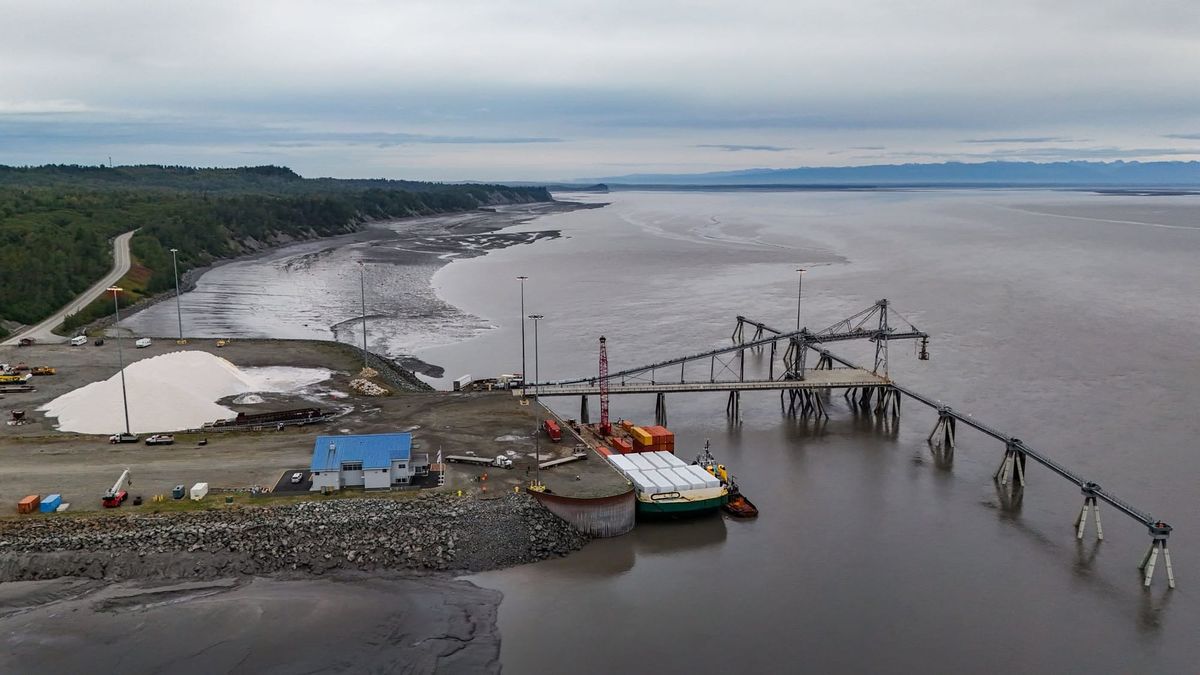
Things are getting busy at Port MacKenzie, the Matanuska-Susitna Borough’s cargo port on upper Cook Inlet.
Construction is underway on two new projects: a gravel barge haul-out ramp and a pilot plant for antimony ore processing.
The ramp is slated for completion this fall. By next summer, Cook Inlet barge operators will be able to move barges out of the water for maintenance and storage, said Dave Griffin, the port manager. It’s an important opportunity for new business for the port, which already serves a number of regional barge operators, he said.
Griffin expects about 40 barge landings and loadings at Port MacKenzie this year, most of them related to construction projects in the region and western Alaska.
The ore processing plant is expected to come online by late summer 2027 and will test a proprietary process developed by Nova Minerals for refining antimony ore into antimony trisulfide, a chemical important for defense and technology uses.
The company will transport ore samples drawn from an antimony deposit it’s exploring west of Skwentna in western Mat-Su.
According to project documents, the plant will use a crushing and leaching process rather than smelting, which can carry serious health risks.
While the port has struggled in the past to draw consistent use, the ramp and ore pilot project are part of the uptick in activity and new interest in the port this year, Griffin said.
About 85 people from agencies and businesses showed up at the port’s annual “industry day” Sept. 15, about twice what Griffin had expected. The annual event provides updates on planned projects.
But what Griffin and other borough officials are anxiously waiting for is word on a $300 million Alaska Railroad federal grant application to complete the partly built rail extension from the port to the railroad’s main line near Houston.
First spearheaded by borough officials in 2005, the extension has languished since 2017, when officials shelved the project amid state budget crises. Today, the railbed acts as a magnet for illegal ATV use and dumping.
The Federal Railroad Administration is reviewing the grant application, which was made in partnership with the Matanuska-Susitna Borough. Officials expect a decision later this fall, possibly in November, Griffin said.
But the grant would not immediately pay for the project’s completion. If approved, it must be paired with local funding, expected to come in at $60 million. Griffin said there’s a chance federal rail officials may allow the borough to count part of the $184 million in state funds already invested in the rail extension.
Griffin is optimistic the government will approve the grant because of growing military interest in Port MacKenzie. Rail would speed transportation of equipment from Interior Alaska installations to a marine loading facility, providing an alternative to shipping it by air or moving it by truck or rail to Anchorage.
Visits to the port by officials at Joint Base Elmendorf-Richardson are increasing, and Port MacKenzie is expected to play a support role in the military’s Arctic Edge exercises planned next year, as it did in similar exercises last year, Griffin said.
One fallback plan for the rail extension, if the federal infrastructure grant does not come through or only partly funds the project, could involve private companies, Griffin said.
Two Australia-based private infrastructure companies, Macquarie Capital and Martinus Rail, are considering an equity investment in the rail extension, he said.
Such a plan comes with pros and cons, Griffin said. Private investment would likely allow the project to be built faster, perhaps in two years rather than four, but a federal grant would mean the Alaska Railroad would own the new track free and clear.
Port MacKenzie also received a $34 million multimodal federal infrastructure grant earlier this year, which would be administered through the state Department of Transportation and Public Facilities.
State transportation officials are still in the planning stages, and Griffin hopes more information will be available in November.
Projects funded through the grant include a 110-acre cargo “laydown” pad, construction of warehouses and improvements to utilities, lighting and security, according to a state press release.
Work on the preexisting port railroad track loop is also on the list. The funding is part of $115.4 million in grants for several Alaska projects that were announced earlier this year under the U.S. Department of Transportation’s Port Infrastructure Development Program.
-- Contact Mat-Su Sentinel at contact@matsusentinel.com