
There’s more than meets the eye at Matanuska Experiment Farm
Historic farm on the outskirts of urban Mat-Su is a hub for Alaska agricultural research
What you need to know:
- The University of Alaska Fairbanks' 902-acre Matanuska Experiment Farm is home to a surprising range of agricultural research and public programs. It supports the Cooperative Extension Service and 4-H and has served Alaska farmers and gardeners for more than a century.
- Researchers are studying whether ocean products such as kelp and crab meal can improve livestock nutrition, whether kelp can enhance soil health, and how cover crops and other practices can support sustainable agriculture in Alaska.
- The property also features historic buildings, one of Alaska's longest-running weather stations, community gardens, public trails, educational programs and outreach services, making it both a scientific resource and a community asset.
- Short on time but need the local news scoop? Get free weekly news in your inbox for Mat-Su, from Mat-Su.
PALMER – What most people don’t know about the Matanuska Experiment Farm could fill a barn.
Tucked away in the “Gateway” area at the edge of Palmer-Wasilla on one of the oldest settled plots in the Mat-Su, the experiment farm is a hive of research activity that’s often overlooked by the thousands of locals who buzz past on their daily commutes.
And then there’s the unexpected: a caribou herd, a mischievous moose that could (briefly) control the weather. And, of course, the research: Does kelp make good fertilizer? What kind of plants encourage pest-eating bugs? Do cows like seafood?
Operated by the University of Alaska Fairbanks near the intersection of the Parks Highway and Trunk Road, the farm spans 902 acres of gardens, barns, greenhouses, lakes, trails, hayfields, research plots, and outreach facilities, providing a wide variety of year-round agricultural services to Alaskans. It also houses the Mat-Su/Copper River Cooperative Extension Service district office, the Mat-Su/Copper River 4-H district office, and leases space to the Alaska Department of Fish and Game.
Farm manager Aimee Young said it’s all part of the facility’s mission to conduct agricultural research for public benefit.
“The University of Alaska Fairbanks is the land-grant university for Alaska,” Young said during a recent tour of the farm’s buildings and fields. “As a land-grant institution, our job is to disseminate research we do back to the public.”
Surf and turf
Tina, Louise, and Linda have big appetites, but they’re even hungrier for attention. When a visiting photographer points a camera their way, the farm’s trio of normally shy Angus cows appear transfixed.
“They’re fascinated by the camera,” says Dr. Jim Vinyard, a UAF livestock nutrition scientist. “I don’t think they’ve ever seen one before.”
The cows will soon become a small herd on which Vinyard will conduct experiments to determine how useful ocean-based foods like kelp and crab meal are as mineral supplements. He explained that Alaska is a great place for grazing – except that soils here are deficient in certain minerals cattle need to thrive and protein-rich foods like soy beans don’t grow well here.
Vinyard is hoping to address both those problems from the small feedlot in the shadow of nearby Pioneer Peak. Over the course of the summer, Vinyard will feed the cattle a variety of ocean-based foods to study their efficacy at delivering these proteins and minerals.
“A lot of my research has actually looked towards the water, to kind of make up for that,” he said. “Seeing what we can pull out of the ocean – either farmed or wild caught – to feed livestock, both either as a farm product, like Alaskan kelp, or as a byproduct, like salmon meal or crab meal.”
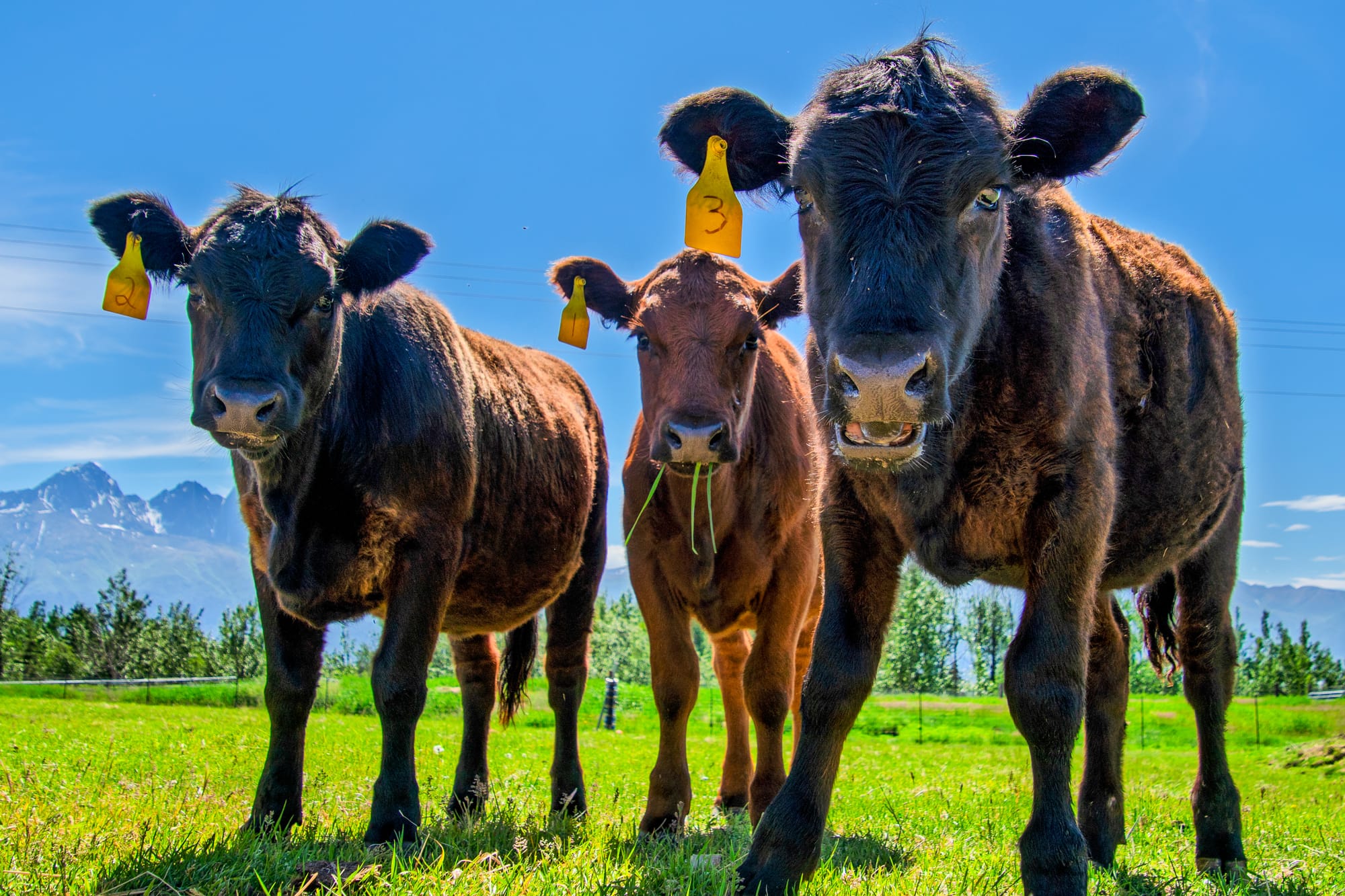
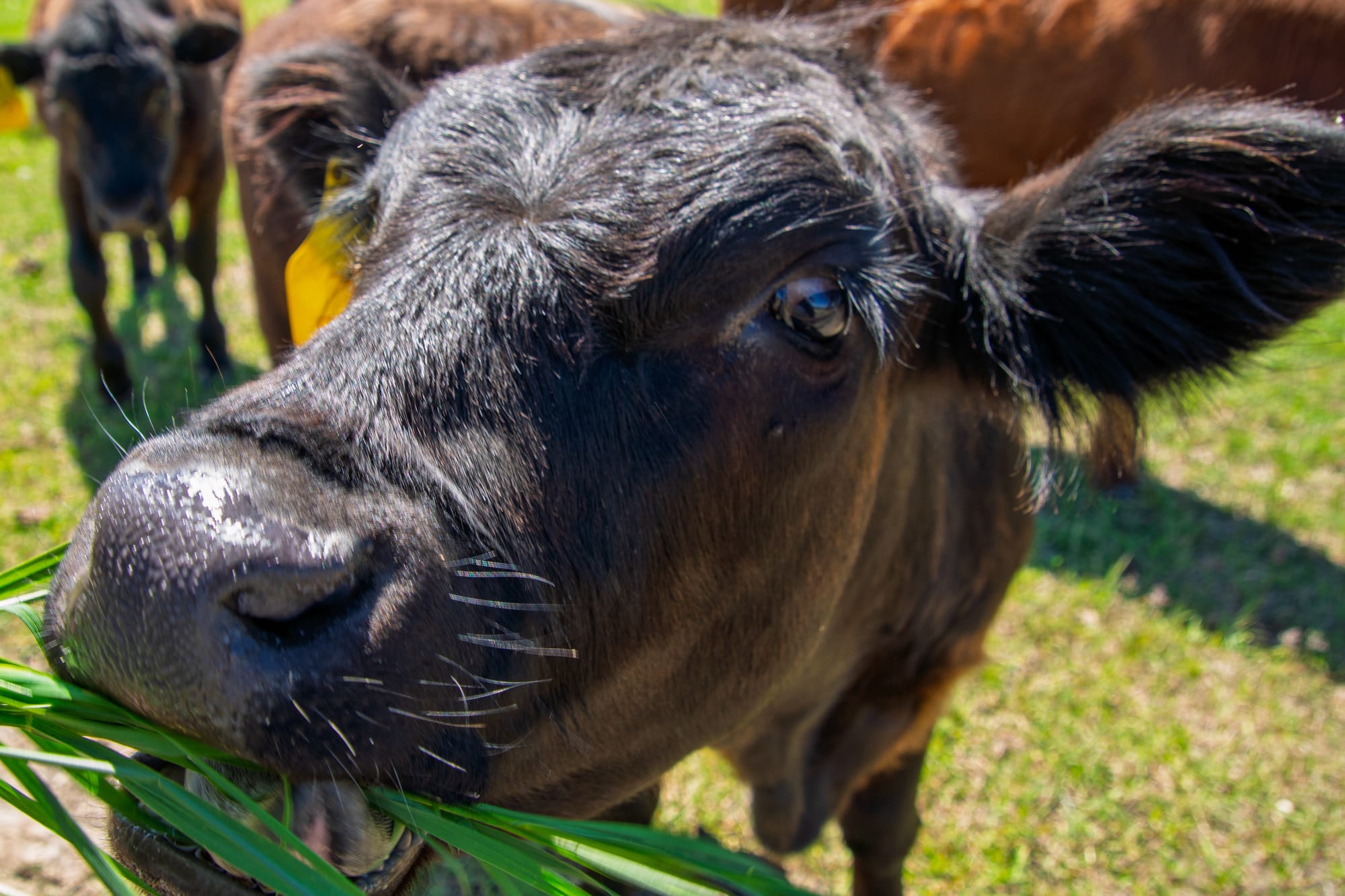
(Left) Angus cows Tina (No. 2), Louise (No. 1) and Linda (No. 3) investigate a camera at the Matanuska Experiment Farm in Palmer on June 25, 2026. (Cade Wolf/Mat-Su Sentinel) (Right) Linda grazes at the Matanuska Experiment Farm in Palmer on June 25, 2026. (Cade Wolf/Mat-Su Sentinel)
Vinyard said farmers have told him cows will readily eat kelp when offered, and the animals will reluctantly eat crab meal if mixed into other foods. If the results are promising, Vinyard said, it could open up new sources of affordable livestock feed in Alaska and elsewhere.
“Anecdotally, there’s some really nice evidence to kind of help support what we’re hoping to see,” he said.
From sea to soil
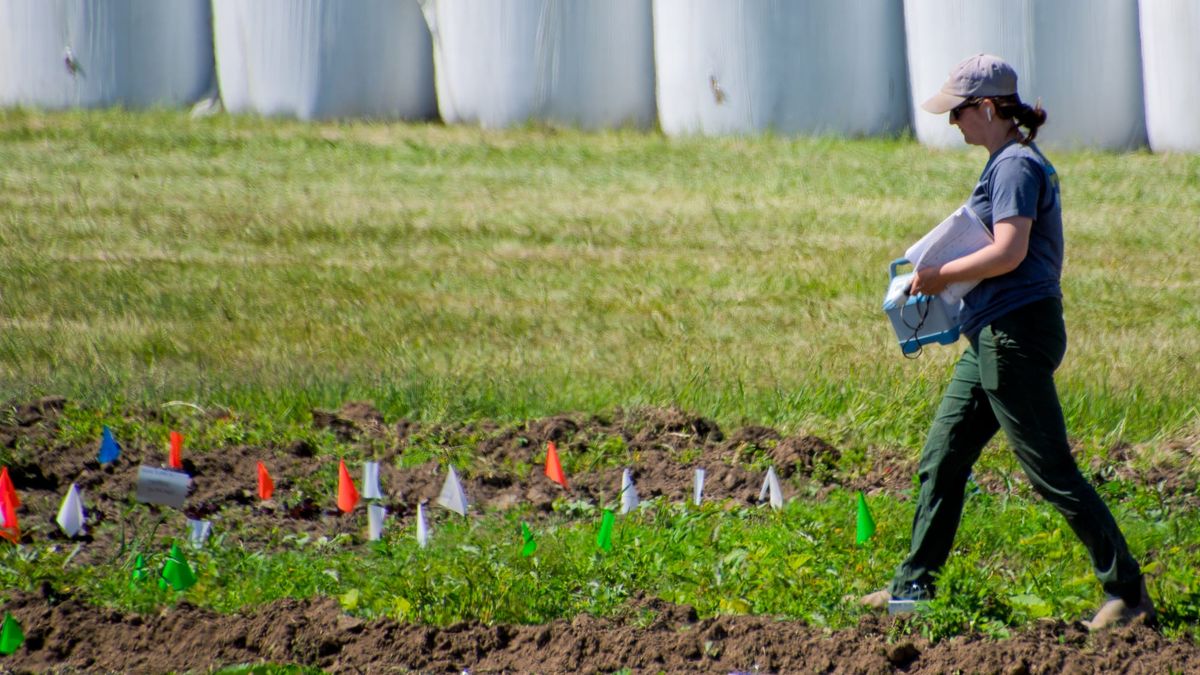
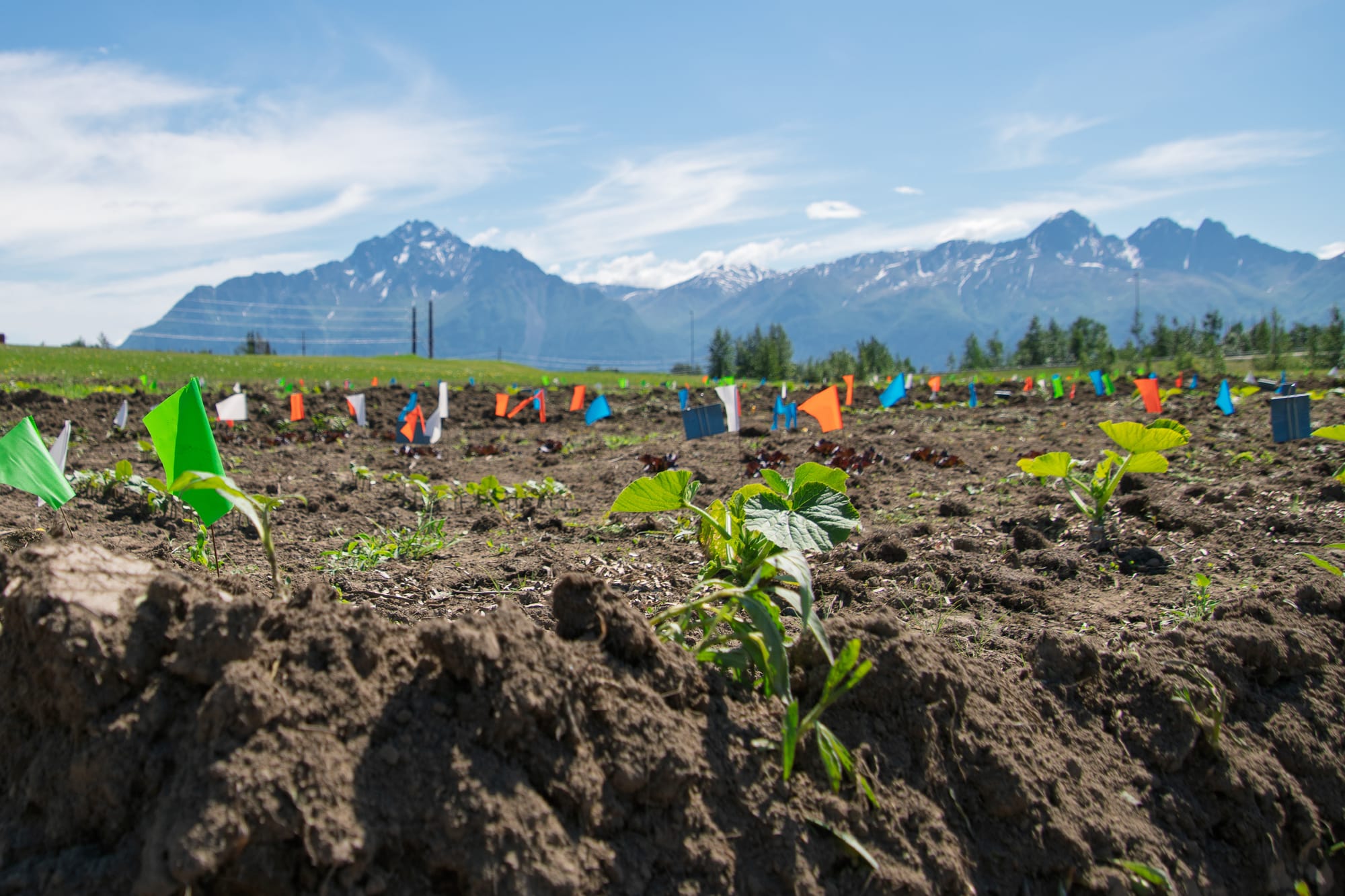
Vinyard isn’t the only researcher on the farm looking into the use of kelp as an aid to agriculture. On the opposite end of the farm from Vinyard’s hungry cows, Washington State University researcher Erin Oliver, who holds a doctorate in ecology, is looking into the power of seaweed to serve as a soil supplement. She tends a small plot of vegetables on which she spreads kelp, then monitors how the vegetables grow and soil conditions.
So far, results have shown modest success.
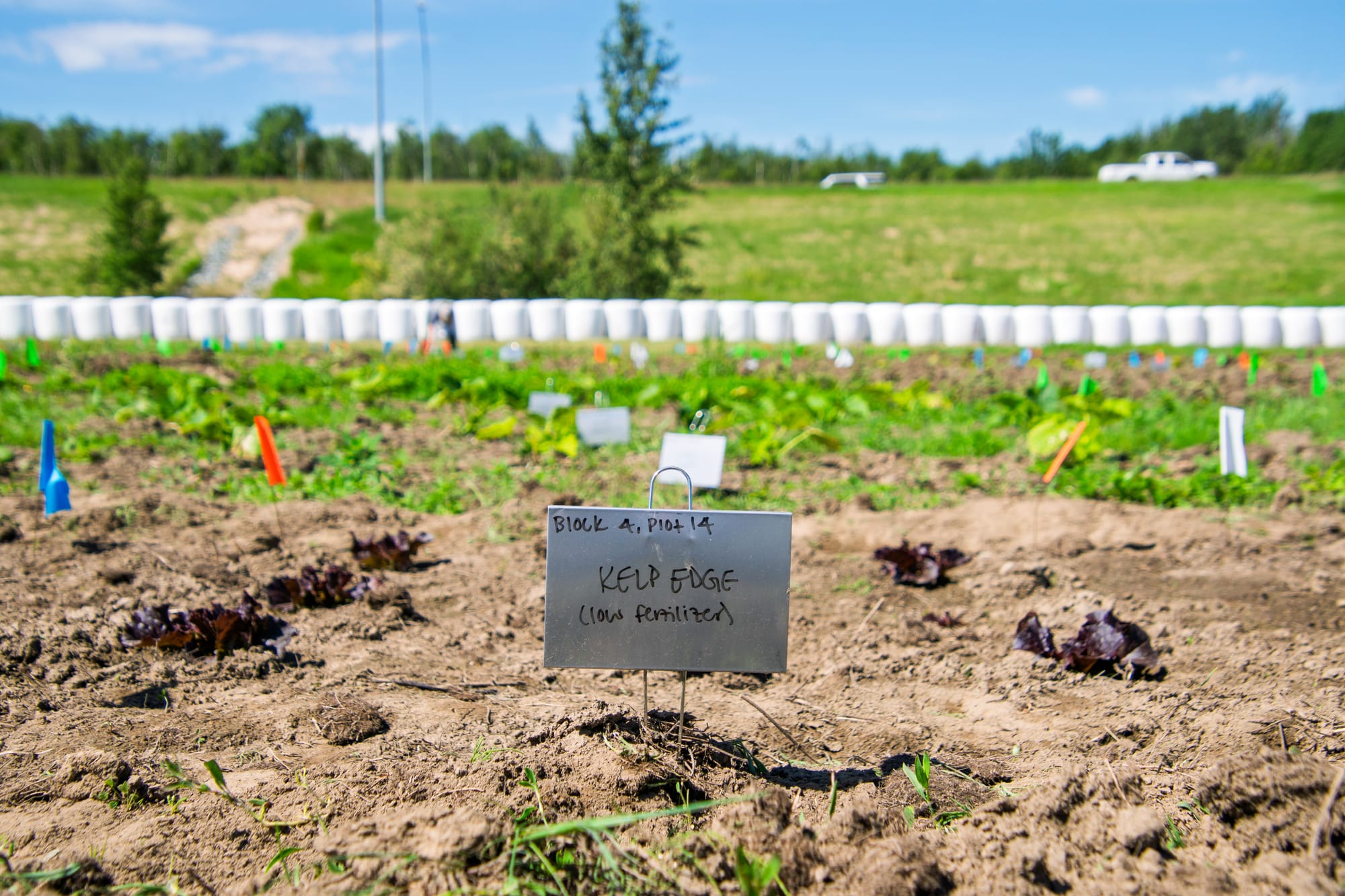
“It’s still to be determined,” Oliver said. “So last year, we found that it did add nutrients to the soil and that it increased the microbial activity with what we want to see.”
However, the carrots Dr. Oliver grew with kelp grew just as well as those grown with commercial fertilizer – and those grown without any fertilizer at all.
Turns out, Mat-Su soils are just too good at producing carrots, and all the plants thrived equally.
“They were delicious,” Oliver said.
This year she’s experimenting on a variety of other crops – zucchini, beets, lettuce – to help better refine the data.
Other fieldwork at the farm includes a project looking at the efficacy of different “cover crops” to promote insects that eat pests, as well as a project to assess the use of hazelnuts as an anchor crop for a “food forest” – which Young explained is a layered plot of land that mimics a natural forest canopy and where several edible plants are grown together.
There’s also work being done by Alaska Pacific University, which rents a greenhouse on the property, as well as the Alaska Department of Fish and Game, which has a small herd of caribou on land it leases there.
Decades of data
Collecting data has been at the heart of the farm’s mission since it was founded as a U.S. Department of Agriculture experiment station in 1915 to serve the needs of early homesteaders settling the area. The weather station established then remains in operation today and has the second-longest history of weather records from a single location in Alaska (one in Fairbanks dates back to 1911). It has gathered temperature and precipitation information daily since 1917 and was modernized a decade ago to collect wind speed, relative humidity, solar radiation, and soil moisture.
While the weather station has operated since World War I, it hasn’t always operated without incident. Young said that about a year ago, the facilities manager who collects precipitation data noticed that the water collected at the station was apparently evaporating at an astonishing rate.
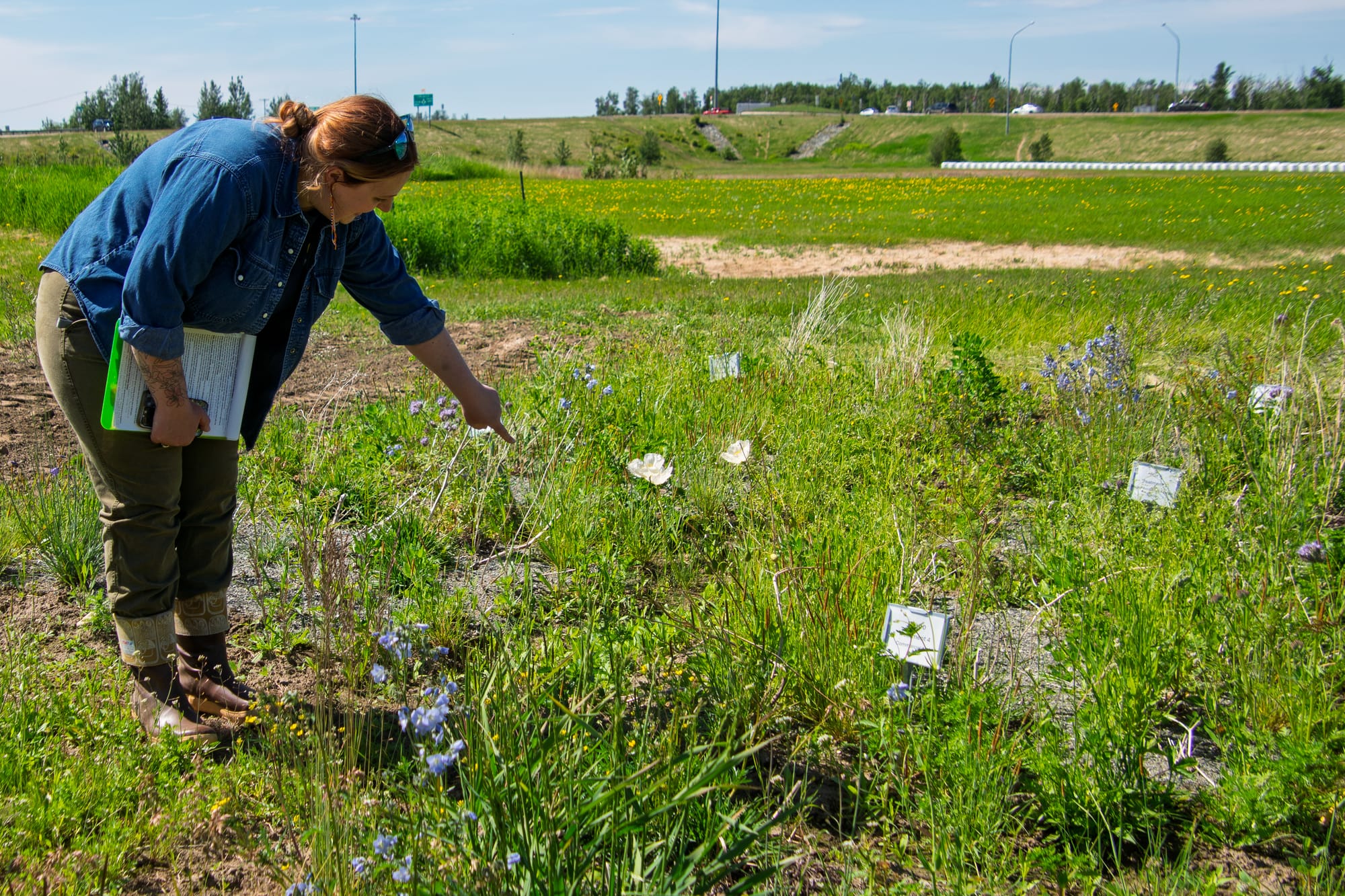
“It was just off the charts. He said, ‘I don’t know what’s happening,’” Young recalled. “And we found out that a mama moose was going through a community garden and munching away, then turning around and hopping the fence and taking a big old swig of water. And that’s how we learned that she skewed the numbers for a good week.”
The experiment farm was originally established on 240 acres just north of the Alaska Railroad line that was then being constructed between Anchorage and Fairbanks, according to a history of the farm on the university’s website. It was later transferred to the territory (later state) of Alaska and has been managed by the University of Alaska Fairbanks since 1932.
Young said those early days are when several historic buildings that still stand today were either constructed or shipped to the property – including the “herdsman’s house” (where Vinyard lives while he conducts his research), a mess hall, a dormitory, the manager’s residence, and a Sears catalog home built at Kalsin Bay on Kodiak Island in 1917 and shipped to Palmer in 1922.
The “Kodiak Cottage” is still occasionally used by visiting research technicians, said Young, who provided a quick tour of the white, two-story wooden cottage. Despite its creaks, the cottage has an undeniable charisma with its original hardwood floors and ultra-steep staircases used in the ready-to-build homes commonly built during the era.
“What charm,” Young said. “I can’t imagine what it was like to live here.”
Feeding minds
Though visitors to the experiment farm are somewhat infrequent, Young said members of the public do stop by to tour the grounds or speak with one of the scientists part of the university’s Cooperative Extension program. She also conducts monthly hour-long tours of the grounds for the public, and the farm will host a research and field tour day July 30.
Young said people who have questions about just about anything agriculture-related can likely get an answer by stopping by Kerttula Hall, the farm’s modern headquarters building located near the heart of the farm.
“We’re open to the public, and at any time they can come in and go through our publications about agriculture, home gardening, canning – there’s a publication on how to make mittens, about how to can walrus, about how to create a root cellar,” Young said. “So you kind of name it, it’s in there.”
The farm also grows about 250 acres of hay, which crews harvest each year and donate to help feed wood bison at the Alaska Wildlife Conservation Center in Portage. The hay is stored in a barn patrolled by a pair of barn cats that Young said don’t have names, are rarely seen, and seem to be extremely good at their jobs.
“They’re professionals.”
Young said there are several community garden plots for local gardeners to grow their own food, as well as an experimental potato patch where each fall the public is invited to harvest as many spuds as they can dig – last year they harvested more than 1,300 pounds.
And that’s not all. The farm is also home to the District 4-H headquarters, where District Coordinator Samantha Blumenkonig manages the youth development organization’s work in the Mat-Su.
Blumenkonig said that while 4-H is mostly known for helping kids raise crops and animals, it also offers programs in things like sewing, art – even coding.
“If you can dream it, 4-H can help you make it happen,” she said.
The Kerttula building also houses classrooms where public programs are held and even a teaching kitchen.
There are also public hiking trails on portions of the property that form a portion of the nearly 3,000-acre Matanuska Greenbelt – though those who used to access them through the farm headquarters are now served by the nearby Kin-Win Trailhead.
A 2020 proposal looked at using sections of the UAF-owned trails for gravel extraction, raising alarms among users. Officials later walked back that plan, instead proposing a conservation easement for that section of property, with costs covered by the Mat-Su Health Foundation. A final decision on the issue has not yet been made.
Despite all that goes on at the farm, those who work there said they often get questions about what occurs there from locals unfamiliar with the place.
“You don’t see a lot of what goes on here,” Vinyard said.
It’s a spectacular setting to visit, with sweeping views of Pioneer and Matanuska peaks, as well as a bird’s-eye view of the nearby Mat-Su Regional Medical Center. The main building is perfumed with the smell of wildflowers, and seemingly everywhere there’s the buzz of a bee or the flick of a dragonfly’s wing.
Aside from the occasional whiff of cow, it’s also an idyllic place to work, Young said.
“I don’t know how you could ever get sick of this view.”
-- Matt Tunseth is a freelance writer from Southcentral Alaska. Write to him at matthew.tunseth@gmail.com