
Travel down to the Kenai's late-run coho
Hit the road if you're feeling not quite done with the salmon fishing season.
What you need to know:
- The Kenai offers late-season fishing opportunities for both boat and bank anglers, with bait allowed in some areas and single-hook artificial lures required in others.
- Anglers should prepare for cold temperatures and encounters with wildlife such as bald eagles, sea gulls and occasionally bears.
- Check current state fish and game regulations before fishing.
- Short on time but need the local news scoop? Get free weekly news in your inbox for Mat-Su, from Mat-Su.
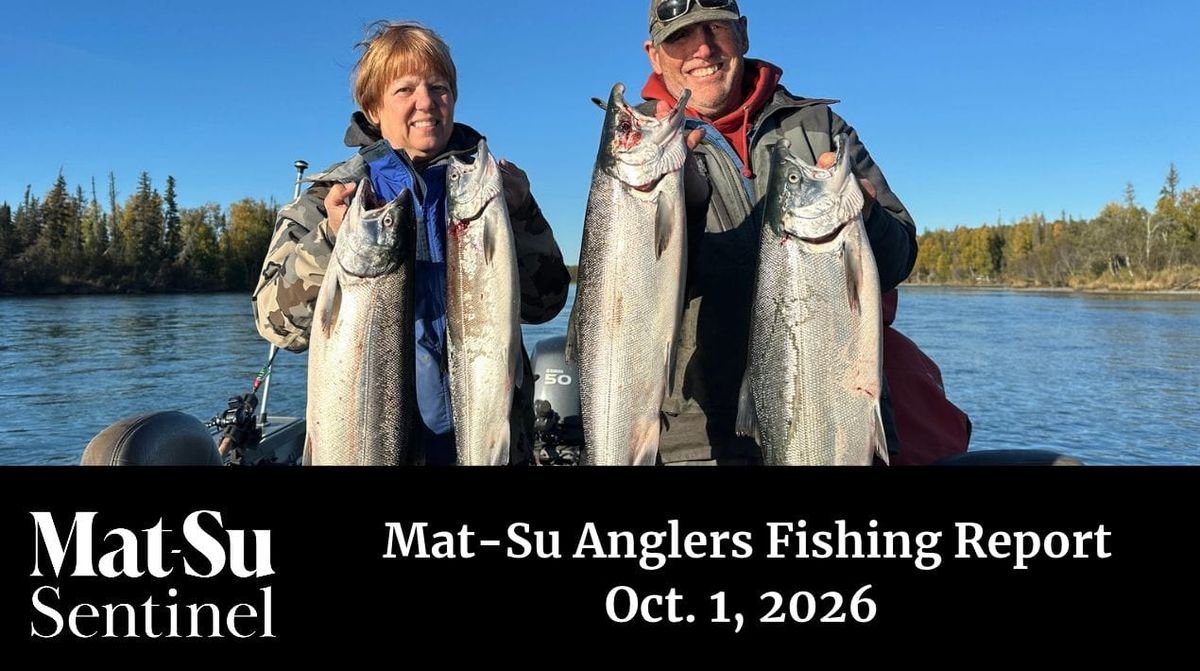
The clear sky was already bright, although the sun was still below the horizon, when we stepped into Pete Imhof’s boat. My wife, Frede, Pete and I, all bundled in layers of warm clothes, motored a short distance up the jade-colored Kenai River and anchored in slower water near shore. Next, Pete showed Frede how to back a sardine-wrapped plug 50 feet downstream and place her fishing rod in a rod holder. Pete and I baited up with cured salmon roe. He back-bounced his bait with a chunk of lead along the river bottom while I drifted mine farther downstream under a bobber until the float became difficult to see.
Although we saw a seal swimming and diving nearby, our anticipation of an ocean-fresh coho grabbing one of our baits was, so far, greater than any evidence that the fish were there. We did, however, spot several salmon carcasses washed up along the bank, along with spawned-out sockeye and pink salmon still wiggling as the current carried them past the boat. Pete was first to score when a zombie pink salmon grabbed his cured roe. Pete appeared less than thrilled as he hauled in a fish that fought like a wet dishrag, while Frede and I wholeheartedly congratulated him on his catch.
A few minutes before 9 a.m., Frede’s rod doubled over in the holder as a coho thrashed on the surface, her plug in its mouth.
This was no zombie fish. Pete immediately grabbed the landing net, but it took Frede several minutes to battle the fish upstream against the current. In the swift-flowing Kenai, coho can be lost when fought upstream against the current. For that reason, boat anglers often pull anchor and follow hooked fish downstream to improve their chances of landing them. We stayed anchored, and the fish remained solidly hooked until Frede brought it to the boat. A flurry of action followed, with Frede and Pete each boating another coho while I couldn’t manage a single hookup.
Almost as soon as it started, the action was over. We continued fishing and finally saw a fish surface about 50 yards downstream, then spotted a bank angler stepping to the water’s edge to land it. That fish was lost, but a couple of anglers were fishing that stretch of bank, and we watched them hook three more coho before their action ended.
If you go
The Kenai is a large river where anglers can harvest chrome late-run coho through Oct. 31 from Skilak Lake downstream to the Moose River confluence sign. Below that sign, coho salmon are open for harvest through Nov. 30. Anglers have plenty of water to work while searching for coho.
Once anglers find a productive coho travel lane, boat and bank anglers alike often stay in a relatively small area and wait for a resting or moving group of fish to come through. If the group is small or moving upstream quickly, the action may be brief, so getting baits or lures back into the water quickly after landing a coho can increase the chance of catching another fish before the school moves on.
Many experienced anglers like to start fishing for coho at or before first light, but angling pressure drops considerably after mid-September, and undisturbed coho may be caught throughout the day.
During the two days Frede and I fished with Pete, we caught three coho each morning. After taking a lunch break, we hooked and lost only one coho the first afternoon. But on the second afternoon, when Pete’s wife, Debbie, joined us, we caught four. Over the two days, each angler caught a daily limit on one of them.
The most recent Alaska Department of Fish and Game fishing report for the northern Kenai Peninsula lists several locations where bank anglers may access the river and catch coho salmon.
Several guide/charter operators are currently running Kenai River trips for coho salmon. Trips generally cost more on the Kenai than in the Mat-Su Valley.
Regulation review
Single-hook artificial lures are required in the section between Skilak Lake and the Moose River confluence sign. While not mentioned in ADF&G’s fishing report, bait is allowed downstream of the Moose River confluence sign through Nov. 30.
Many coho anglers choose this area specifically because bait is allowed, and Pete has told me anglers have a significantly better chance of catching Kenai coho with bait. Pete also said more guide/charter operators are now working the artificial-lure-only area because greater concentrations of coho often stage there during late September and October. Dustin Slinker also told me there were plenty of coho and trout in the section below Skilak Lake when he fished it this September.
Other regulations apply to specific portions of the Kenai, so I recommend reviewing ADF&G’s free Kenai River fishing regulations booklet before fishing.
Note: By emergency regulation, ADF&G reduced the Kenai River coho salmon daily bag limit to two fish per person. I don’t anticipate any additional in-season regulation changes, but it never hurts to check, especially before making the several-hour drive to the Kenai Peninsula.
The sport fishery restriction for late-run Kenai River coho is notably less severe than the multiple restrictions, followed by a harvest closure, imposed on the Susitna River drainage and Little Susitna River sport fisheries in the Mat-Su Valley during 2026.
Expectations
You will likely see lots of sea gulls and, depending on the section of river, anywhere from a few to a whole lot of bald eagles. The birds congregate where spawned-out salmon carcasses accumulate. Bears are also sometimes spotted below Skilak Lake, especially early in the morning.
Expect cool or very cool fall temperatures along the river, especially in the mornings. Temperatures can also drop quickly in the evening. The moisture along the river can make the air feel cooler than the temperature suggests, so plan ahead and wear enough layers to be comfortable.
Fresh coho will continue arriving in the river, and late-run Kenai fish are larger than those anglers typically see in the Mat-Su Valley. Don’t necessarily expect instant gratification, but the reward may be well worth the effort.
Andy Couch has guided Mat-Su Valley fishing trips for over 40 years and is a member of the Matanuska-Susitna Borough Fish and Wildlife Commission and the Matanuska Valley Fish and Game Advisory Committee. However, statements and quotes in this column represent specific organizations or individuals only when so noted.