
U.S. presidents in Mat-Su: A history of unlikely encounters of the Valley kind
There are only three such visits, and one of them includes a president operating a train.
What you need to know:
- Presidential visits to Alaska have largely bypassed Mat-Su, with most presidents limiting their trips to Anchorage or Fairbanks. Only a handful of presidents or future presidents have ventured into the Mat-Su region.
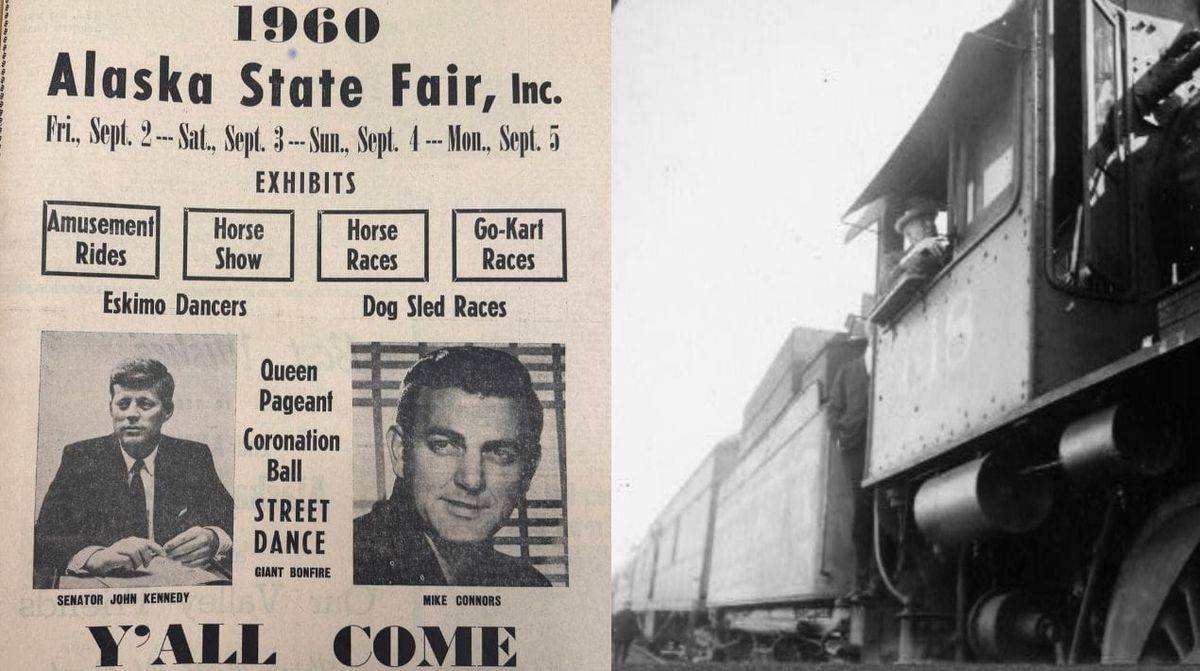
- Warren Harding and John F. Kennedy provided two memorable early encounters. Harding passed through the Valley by train in 1923, briefly taking the locomotive controls with less-than-perfect results. Kennedy visited the Alaska State Fair in Palmer during his 1960 presidential campaign, encountering muddy conditions, enthusiastic crowds and anti-Catholic protesters.
- Jimmy Carter's 1980 fishing trip brought a sitting president deep into the Talkeetna Mountains. Despite widespread Alaskan anger over his conservation policies, Carter enjoyed a successful day catching grayling at Clarence Lake, where he also befriended a surprised family of vacationers. His visit underscored how rare presidential appearances in the Valley have been.
The history is clear, especially in more modern times. If a sitting U.S. president visits Alaska, it tends to mean a quick few hours in Anchorage, with as much refueling as anything else. Donald Trump in 2019 and 2025. Joe Biden three times from 2022 to 2023. George W. Bush in 2002 and 2005. Bill Clinton in 1994. George H.W. Bush in 1989. Ronald Reagan in 1983. Jimmy Carter in 1979. Gerald Ford in 1974. Richard Nixon in 1971. Lyndon B. Johnson in 1966. Dwight D. Eisenhower in 1960. Anchorage is the easy choice: a population center, a military base and runways long enough for Air Force One.
If a president is feeling spicy, they might mix in a trip to Fairbanks. Gerald Ford in 1975. Ronald Reagan in 1984. George W. Bush in 2008.
There are the wilder exceptions. Obama visited Anchorage in 2015 but also made it to Dillingham, Kotzebue and Seward. The sun will likely extinguish before a president visits Dillingham again.
Ford visited Pump Station 8 on the Alaska Pipeline during his 1975 visit, beyond the bright lights of metropolitan Salcha. Franklin D. Roosevelt fished on Buskin Lake at Kodiak in 1944. And Warren Harding touched soil at Metlakatla.
Then there is the Valley. If the history of presidential visits to a region is centered on an anecdote from 1923 — roughly 30 years before there even was an Air Force One — then it is safe to say that region is not presidentially favored.
The summer of 1923 meant it was Voyage of Understanding season, President Warren Harding’s doomed effort to combine a reelection campaign, public relations gesture, fact-finding mission and an escape from political scandals into a vacation. Upon departure, he never saw home again, killed by a heart attack in San Francisco on the long return. The long-tongued, facetious wags gossiped that Alaska had killed him, or of more literal murder, or of any number of crazy conspiracies.
Harding’s traveling company included Commerce Secretary and future President Herbert Hoover. Alaska, naturally, marked the distant end of the Voyage, beginning in Metlakatla and continuing through Ketchikan, Wrangell, Juneau, Skagway and Seward.
From Seward, his party took the train to Anchorage and arrived late on July 13, 1923. Like many tourists in the years since, Harding picked up a landscape painting, this one by Sydney Laurence.
From there, he continued north by rail. This marked the first presidential visit to the Valley, however in passing that it was, landscape seen through the windows of the train. The highlight was Harding’s brief turn at the locomotive controls, in the stretch from Wasilla to Willow.
On July 14, and after some brief instruction, he grasped the throttle under the watchful gaze of the first lady at the other side of the cab. It did not go well. Per the Anchorage Daily Times, “The president was described by the engineman as a good engineer, but the dining car steward as poor on stopping, as he slowed the train down with a jerk which broke eleven cups in the diner.” That was their Valley highlight.
At the Tanana River Bridge on July 15, he drove a golden spike to ceremonially mark the completion of the Alaska Railroad.
Unfortunately, the president was about as handy with a spike maul as he was with the train throttle. From The New York Times coverage, “The President lightly tapped the gold spike twice with a silver sledge hammer. Then Governor Bone quickly withdrew the spike and replaced it with one of ordinary steel…President Harding lifted the silver sledge higher for a more substantial blow on the steel spike. He missed it. A second attempt also went wild, the hammer striking the rail of the track. Then with determination in his eye the President took good aim. This time he drove the spike nearly to its head. Another blow finished the job.”
That was Harding’s — and Hoover’s — adventure in Alaska. The office of the president and the Valley then renewed their longstanding distance from one another.
John F. Kennedy was not quite yet elected when he made the journey to Palmer on Sept. 3, 1960. That election was the first where Alaskans could express their presidential preference with an actual ballot.
Both Kennedy and rival Richard Nixon campaigned in Alaska, but Kennedy deserves credit for going as far as the Alaska State Fair, where he did all the things a candidate does in hopes of an extra vote or two. He flew into the Palmer airport, traversed the few miles to the fairgrounds in a 17-car procession, posed with cabbages and donkeys and speechified in the looming shadow of a Ferris wheel.
For the youthful senator, it was an authentic Alaskan experience. Amid the carnival atmosphere, he battled the mud like all the regular attendees. Fairgoers helped push his car out of the muck. Others passed out anti-Catholic fliers to the crowd at the speech. Kennedy was the first Catholic president, only the second serious Catholic presidential candidate.
He spoke to a crowd of “between three and four thousand” who crowded into the grandstand and stood on the fairgrounds’ racetrack, according to an article in the Frontiersman recapping the visit.
Kennedy noted that he was from a small, old state, now standing in a new, large one, metaphorically and literally crossing the entirety of the country and its history. And he found insight in that transition.
He declared, “I do not say that the future will be easy—I do not say that the 60’s will be a golden age. But I do say that the opportunities are as unprecedented as the problems—that we need courage more than despair—and that all the challenges of the New Frontier can be met, and met successfully—if we only apply to that New Frontier the same dedication and spirit which you in Alaska applies to the ‘Last Frontier.’
Finally, as in before 2026 finally, there was President Jimmy Carter’s 1980 visit. In 1978, he invoked the 1906 Antiquities Act to create 15 national monuments in Alaska and enlarge two others, withdrawing 56 million acres from possible resource development, a step toward the 1980 Alaska National Interest Lands Conservation Act. And boy did that anger many Alaskans.
Carter effigies were burned in Fairbanks and drowned in Ketchikan. Protesters carried signs with him in a noose. Advertisements compared him to Hitler. Alaskans shot at Park Service planes and invaded what is now Denali National Park, intent on violating as many laws as possible.
Two years later, Carter was intent on seeing some of the land he fought to preserve. On July 10, 1980, a Marine helicopter flew him, Secretary of State Edmund Muskie and Alaska Gov. Jay Hammond north out of Elmendorf Air Force Base. They circled the mountains, gazed at majesties and briefly landed on a glacier. Then they took off for Clarence Lake in the Talkeetna Mountains.
Carter was an avid fisher, tied his own flies and everything. The Secret Service, attended by state Sport Fishing Director Rupe Andrews, scouted five potential lakes for the getaway and perhaps had their own fun along the way. A Hammond press aide told the Anchorage Daily News, “The Secret Service agents were even fishing each site as they went.” To them fell the burden of picking a site that matched weather, vistas and plentiful fish. And so, they settled on the picturesque Clarence Lake, perched in an alpine meadow, deep in the Matanuska-Susitna Borough.
It was a beautiful day as they worked one of the creeks feeding into the lake, what Carter called “one of the best days of fly-fishing” he ever had. At first, he tried some Alaskan-made ties without much success. From his hunting and fishing memoir, “An Outdoor Journal,” he switched to his own design, an imitation caterpillar he called Irresistible. Then he “began to catch fish regularly.” Over five hours, he caught 24 large grayling. Four of them were pan-fried on the spot as their breakfast. The rest were released.
“He’s one whale of a good fisherman,” said Gov. Hammond. “Frankly, he caught more than the rest of us put together. And he did it on his own flies.” He added, “Those fish knew who was president.”
The group included the president, assorted dignitaries, armed Secret Service agents, varied wildlife and a random family from Oakland, California. The Brauners — father Howard, mother Kathy and daughter Lori — had been there a few days, the centerpiece of a fishing trip they had spent months saving for, the escape people dream about their entire lives. Only, they hadn’t expected as many helicopters at an isolated mountain lake.
For some reason, Marines kept visiting, only they were vague about the reasons. Then, it just happened, the descent of a fleet of helicopters, one of them rather obviously featuring the presidential seal. The Secret Service escorted the Brauners out of the water, but Carter made a point to include them in the day, fishing and talking with them.
Howard stated, “Mostly I was tongue-tied and kind of nervous. We talked about fish, and the President showed me how to fly cast.” He continued, “He’s a good fisherman. I hadn’t caught anything until he showed me how to fish.”
And that is the history, pre-2026, of presidential visits to the Valley. History suggests it might be a while longer after this week.
David Reamer writes about Alaska history.